Sunday, November 28

Movies You Should Totally See: Synecdoche, New York

I was browsing DVDs with my mother one day when I stumbled upon this movie. I enthusiastically urged her to buy it, and she asked me what it was about. I thought for a while, and then said: "everything". She didn't buy it. Everything was too much for her.

I can see why she did this. Synecdoche, New York is not a movie for people who just want to unwind after a long day. In fact, of all the movies I have ever advocated on this blog, this might be the one that the fewest people will appreciate. Even the critics were polarized about the movie: Roger Ebert called it the best movie of the decade, while others called it pretentious, too complex and generally stuck up it's own ass.  And I have to admit, you have to swallow quite a bit of Charlie Kaufman's crazy imagination to make any sense of the movie. But if you're willing to give yourself over to the movie you will find it's incomparably deep and moving. Or at least unlike anything you've ever seen before.

Synecdoche is first and foremost about life. The story is true to it's source: huge, complicated and sometimes downright bizarre. We follow the protagonist, Caden Cotard, from his midlife crisis to his death. The first part of the movie shows him being just another unhappy guy with a broken marriage. His job as a theatre director grants him some satisfaction, as do his awkward flirts with the receptionist Hazel, but even in those areas he mostly ends up frustrated. It's then that he gets the chance of a lifetime: a grant of 500.000 dollars to make a play. His ultimate work of art. He sets out to recreate his entire life in a gigantic empty warehouse, and hires actors to play himself and everyone around him. When the original people and the actors who play their love interests start falling in love the movie gets so devilishly complex that I won't even attempt to explain it. 

Synecdoche is not a movie in which the symbolism is subtly interwoven with the movie. The symbolism is the movie. Everything about the characters, from their names to their tiniest actions, is relevant and meaningful in some way. But I appreciate Charlie Kaufman (the director) for doing this. He takes the audience seriously, and throes them into the deep to show it. There is so much to say and to discuss that no time is wasted on stuff we can figure out by ourselves. It doesn't make for easy viewing, but it helps make the movie as labyrinthine and massive (in the best way possible) as it is.


This is not a happy movie. In fact, it's a rather sad movie. It shows old people who got busy dying (to quote a phrase) a long time ago, and are now desperately trying to leave some mark behind. It also a movie about how we are all trying to set up our lives like an enormous play, with ourselves as protagonists, just so we can make any sense of the crazy world we live in. This movie is a slap of reality and a dreamy exploration of life at the same time. Both a movie about creation and destruction. Both a flawless masterpiece and a self-absorbed pretentious pile of shit. Maybe I was wrong about saying that this movie was about everything. In a very strange way, this movie is everything: beautiful, worthless, strange, haunting, saddening, and ultimately pointless. Like all great art. And like all great pieces of art, this is not something you will ever completely figure out or agree about. Which is exactly what makes it worthwhile.

Alias

Ladies and gentleman: The Album Leaf!

Thursday, November 25

Shorts Circus: Hot 'n' Cold

This is basically just a silly video I found. Next week I'll return to the more serious stuff, but I liked this so much I thought it would be worth spreading.


Alias

Wednesday, November 24

Review: Princess Mononoke

Something that has always intrigued me about Japanese movies is their use of mythology. Most western movies deal with evil as something that is inside people, something you can avert by living virtuously. But Japanese movies, with their pagan mythology, deals with morality in a completely different way. I'm by no means an expert in anything Japan-related, but my impression is that they view the struggle between good and evil not something man is spiritually caught in between, but physically. You can at any moment get attacked by demons for no particular reason. If you don't fight, it will kill you dead. End of story.

Besides the fact that this is much manlier, it offers a completely different movie-watching experience. Instead of focussing on the psychology of one or two characters and have the story driven by them, Japanese movies often feature a large group of people struggling with forces as elemental and massive as life and death. Their intentions are clear, and you can mostly sympathize with their struggles, but the morality of their actions is never clear or simple. Couple this with the wealth of symbols of Shinto, one of the largest polytheistic religions in the world, and a very rich folklore, and you have enough source material to make some pretty magical films.

And that is exactly what Princess Mononoke is: magical. Not magical in the way that Disney movies are magical, that's pussy magic. Magical in the same way you feel when you see the world from atop a mountain, and realize how huge everything is. Magical in the same way you feel when you watch the stars on a quiet night, and reflect on your vulnerability and the mysteries of the universe. Magical in the same way you feel when you walk on the grass barefoot and daisies get stuck between your toes. 

Those little fellas are called Kodama. They are basically the coolest thing ever.
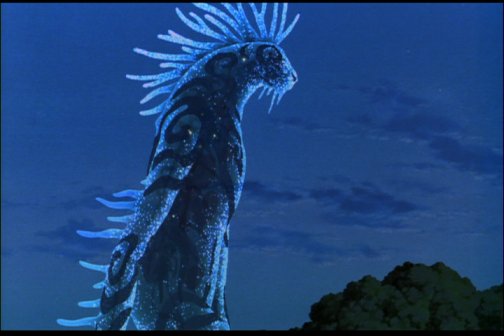
Princess Mononoke tells the story of Ashitaka, a young prince whose village gets attacked by a giant demon god. When he kills the beast, a curse is put on him. The village elders tell him that there is nothing he can do about this: the curse will slowly deteriorate him until he dies. Without as much as a blink, he accepts his fate and sets out to the west to find and destroy the source of this curse. When he arrives, he find himself in the middle of a conflict. There is a war going on between Lady Eboshi, a militant woman who runs an iron forgery and Mononoke, a child raised by wolfs who hates humans and tries to protect the forest she lives in. It's a masterstroke that Miyazaki didn't make this conflict one-dimensional: Eboshi might destroy the forests for her industry, but she is also the caring head of an entire village of people who are really quite nice. And although Mononoke might seem the ideal protector of nature at first, she is also a moody and vengeful child with little regard for anything other then her own ambitions. And then there is the mysterious Deer God, the deity of the forest who seems to represent the natural order of things, without the meddling of man.

This is only one of the many tales that goes on within the world of Princess Mononoke. A slew of secondary characters (that would be able to carry an entire movie on their own) inhabits the movie, but their stories just play in the background, without really influencing anything. It really feels like the movie takes place in a universe on itself. This is helped more than a little by the absolutely gorgeous animation. Hayao Miyazaki is the head of the only film studio in the world that still works primarily with hand-drawn animation, which basically makes him a saint in my book. The drawing is so amazingly beautiful and complex that it's a miracle it works in motion, but it does. Fantastically.

Imagine this thing moving.

Anyone still dismissive about the merits of animation will be convinced by this movie. It tells a tale that could never have been told by live-action, in a universe that could never have been created with live-action. This is not a children's movie. Not even a teenagers movie. This is epic Japanese fantasy in the legacy of Akira Kurosawa, and if you're in any way interested in having your mind blown you should not let this pass.

Alias

I think there are very few people on the planet who can express the atmosphere in movies like this. Jonsi is one of them.