Sunday, January 9

Review: Dead Poets Society

Hitchcocks movies are often described as machines. When you sit down to watch them, you are fed into them. Mr. Alfred will then make you a puppet on his strings, making you feel exactly how he wants you to feel. You emerge scared shitless, laughing or with a silly grin on your face. This is the way most Hollywood movies are: experience in a can. The good ones, at least. The shitty ones don't feed you emotions, but little signs reading "feel (emotion X) now". You completely see through the illusion that way, which makes the movie obnoxious rather then moving. An excellent example of this is Dead Poets Society, a movie that tries so hard to make us cry it only made me groan.

The movie tells about a group of gifted youngsters who are being held down by The Man in the form of a repressive school system. But then they get classes from a cool and inspirational teacher, who opens their eyes to the beauty of the world and their true potential. But although the people in charge try to put them down, in the end they all... what do you mean, that is the plot of a thousand other movies? Well, this one is different, because it ends with one of the boys killing himself and the teacher getting fired. So much for the all's-well-that-ends-well moment at the end that is always the high point of movies like this.

They do stand on their desks, though. So there's that. Dude still gets fired, though.

What's even worse, though, is how untrue Society is to exactly the point it's trying to make. Tom Schulman, who wrote the movie, apparently wants to advocate a free-thinking, romantic sort of lifestyle. He did so by writing a sentimental, melodramatic movie. But the worst crime it commits is playing it safe. There isn't a single deviation from the formula here. Come on, Schulman! Just making the characters cite tons of poetry doesn't make them romanticists! In fact, it makes them come of as whiny bitches, instead of the heroes in agony you want them to be. You can have all the criticism you want on the romanticists you want, but at least they were sincere. 

Schulman was educated in a restrictive, authorial school himself, so you could see it as a way of coming to grips with his youthful ideals. But what is there to take away from this? Schools like that don't exist anymore, and children nowadays are being encouraged to be creative and free-thinking and such. This movie is about a problem that was solved before I was even born and how bad it was. This was not a rebellious act when it was made, and now it's even more painfully safe. If you want to see a movie about a true rebel, go check out Steven Soderberghs monumental Che. That guy had balls in the face of death, and the movies are made that way too. Dead Poets Society doesn't even have the stones to mix things up in the face of bad reviews. Get the fuck over yourself.

Alias

P.S. If you think I'm being hard on Schulman: the man won an Oscar for this piece of shite.

Now THIS is an honest song.

Friday, January 7

Shorts Circus: The Hallway

The woman who made this installation piece is called Miranda July. I'm sort of in love with her. And even though this is not technically a film, it's my favorite thing of hers so far.


The Hallway from The Hallway on Vimeo.


Alias

Wednesday, January 5

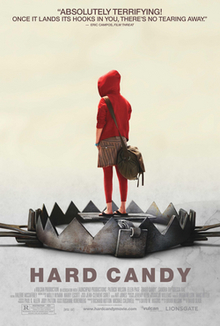
Movies You Should Totally See: Hard Candy

Aristotle said that a good play should take place in a single location, contain a single central act and should have a time span of less then 24 hours. Most movies break these rules almost immediately, but there is a certain quaint type of film that still sticks to these rules. One room, a few people, real time. No flashy action, no grand narratives, just people talking.

Hard Candy had a grand total of three actors with dialogue, and one of those has about 20 seconds of screen time. Everything in it takes place within a single afternoon, within a single house. This is the house of Jeff, a charismatic photographer who mostly works with young girls. Very young girls. When the movie starts, we see him contacting his next model. He meets her in a coffeehouse, and invites her over. She pours them both cocktails. He suggests a photoshoot. She happily obliges. He fetches his camera. He walks back into the room. And he passes out. When he wakes up, he is tied to a chair, while the girl is mockingly looking down on him.


It's a bit of a cliche to call a film like this a game of cat and mouse, but the term was never more fitting. The girl has a plan, but how solid is the evidence for her accusations? How much is she telling? The man is into some fishy business, but does he actually deserve what is done to him? The film peels off the layers of lies slowly and deliberately, in a way that pretty much defines "gripping".

Aristotle based his rules on the theatre, an artform that (in his day) depended mostly on two things: a good script and great actors. The script of Hard Candy is perfectly fine, but you'll completely forget about it once the actors show up. Patrick Wilson does a great job as the man in a tight spot, but he is simply no match for Ellen Page. Watching her unleash all hell is a simply chilling experience, even more so because she portrays her character as a complete enigma. Even in the most vulnerable of moments it is never revealed how much she really knows, and when the movie is done many questions remain unanswered. It's an uncanny achievement, especially when you consider that Page was only 18 when she played the role.

But like the drama Aristotle described, this is something that first and foremost should be experienced. You can (and will) think about it all you want, but there will never be any conclusive answers. Hard Candy is a movie that will keep you in it's grip long after you've turned off your TV.  It's is a hell of ride, and not one you'll leave unscathed.

Alias

This just feels right. Don't really know why.