Showing posts with label Movies You Should Totally See. Show all posts

Sunday, February 13

Movies You Should Totally See: The Rocky Horror Picture Show

When you went to the movies in the 1970's, your chances where higher then any time in history that you'd end up at a movie which was completely batshit insane. It was a decade in which both the public and the filmmakers radically changed: the baby-boomer public was enjoying their new freedom and yearned for more intellectual fodder which they found in the works of Ingmar Bergmans and the French New Wave. The directors, on the other hand, scooped up every single movie they could find, and made some of the most innovative movies ever to come out of Hollywood. Many of these, like Easy Rider, The Godfather and Taxi Driver, are now regarded as some of the finest films of all time.

The new curiosity for things unseen (and more then a little weed) also led to the rise of the midnight movies. When the regular blockbusters had played and the patrons had left, some of the more cult-oriented movie theatres would play these movies. It was one of the least coherent movements in film history, if you can even call it that. Some of the most famous midnight movies include a Public Service Announcement turned unintentional comedy (Reefer Madness), a philosophical western (El Topo) and Earserhead, which I honestly can't describe as anything else then just that. But they all fade into nothing when compared to the most famous midnight movie of all time: The Rocky Horror Picture Show.


Rocky Horror came out in 1975, and it flopped. The makers tried to re-release it as a double bill, and it flopped again. It wasn't until it hit the midnight circuit that something strange happened: the people who had seen it kept coming back. Week after week. And they started talking back at the movie. And dressing up like the characters. And dancing in front of the screen. A bona fide cult was born, and through the influence of these weirdos the movie hasn't been out of running since it was released. In fact, with more then 35 years of unbroken theatrical exhibition it's the longest running movie in cinema history.

So what is it exactly about this movie that makes it's fans so loyal? Well, not "quality" by any conventional standards, that's for sure. It has lousy special effects, generally mediocre acting and the production values aren't exactly staggering either. But that might just be why it works. Movies that we consider to be great usually loose their emotional impact after you've seen them 4 or 5 times, but Rocky Horror sidesteps that by being utterly devoid of things like "restraint" or "taste". It's surprising how much staying power Tim Curry in a corset has.
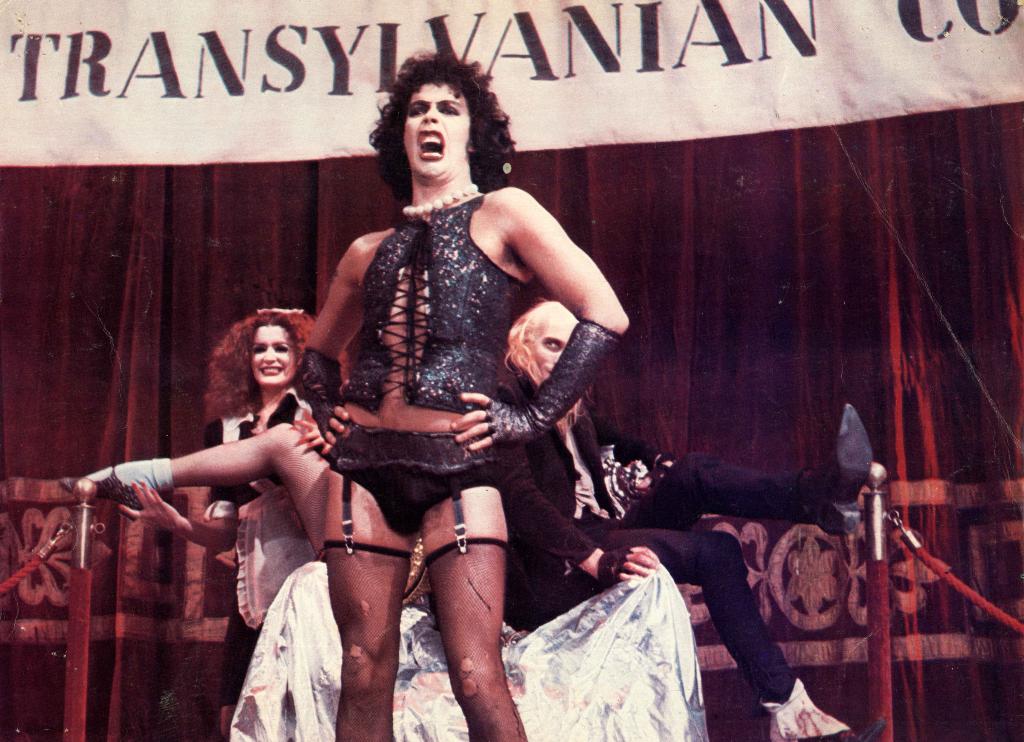

As seen here.

Another thing that makes this one of the most rewatchable films ever is that it's completely fuckballs insane. The plot doesn't make a sliver of sense: people come crashing out of freezers on motorcycles, even the straightest characters go bi and halfway through it's revealed that most of the cast are aliens. The main character is a transsexual mad scientist from Transsexual Transylvania (the planet Transsexual from the galaxy Transylvania, that is) who creates his own boyfriend, a sort of Aryan superman in a golden thong whose first reaction to being born is singing a song. Oh, did I mention it's a musical? Because it totally is.

It should be obvious by now that The Rocky Horror Picture Show is not a film for everyone. If the things I've told you about it appeal to you, this is one that you honestly can't miss. But if it's all a little too strange for your tastes, there's always the new Justin Bieber movie.

Alias

Don't stop me! Don't stop me!

Thursday, January 20

Movies You Should Totally See: Waking Life

Of all the things we experience in our lives, dreams have to be the most puzzling. We can figure out why we think something, and with some personal reflection we can discern why we feel something. But why we dream something is almost impossible to find out. And yet, our dreams seem to tell us a lot about ourselves. For as long as people have slept, dreams have been an endless source of fascination for poets, artists and philosophers, and filmmakers are no exception to that. Besides providing lazy screenwriters with a cheap twist ending (it was all a dream!), there have been many notable films about dreams (in the last decade alone there were The Science of Sleep, Mulholland Drive and Inception, to name a few). But what makes Waking Life so different from those movies is that it's not about dreams. It is a dream.

Although it has a very distinct visual style, Waking Life is first and foremost about people talking. Who these people are, or even where, doesn't seem to be relevant. We simply zoom in on their conversation, and leave when they're done, or when the moment is opportune. We move from interviews to monologues, from lectures to anecdotes. The topics are all over the place, but they're never trivial: society, consciousness, reality, life itself. These are conversations of the sort that you can only wish for most of the time: literate and out-of-the-box, with mutual interest. The dialogue is what keeps the movie going: there is almost nothing in the way of a plot. The dialogue itself is what matters, and it's bliss to listen to. Precisely because there is nothing to move towards, the dialogue never feels rushed or trying to prove something: it is simply moving at it's own pace. Sometimes we hear a 5-minute monologue followed by someone saying a single line, and both make equal impact.


The central figure amongst all this is the unnamed protagonist, played by Willy Wiggins. He talks, but mostly listens. It seems to be that we're exploring his dreamworld: we see him waking up several times in the movie, only to find out later that we're still in a dream. The movie seems deceptively complex: it's entirely possible that it's all set within a single dream. But this is not a puzzle movie. If you just allow the movie to overtake you, it will become a meditation, a shower of good ideas. And just when you think you have grasped what one speaker is saying, another has already taken his place. You won't be able to really ponder upon anything that happens. Instead, you will be made to think about life and the world in general in a way that can only be described as philosophical. The real depth is at the surface.


This is not a movie to explain. This is a movie to experience, talk about, inspire people and spark conversations. Many people will resist a movie that's not to be figured out, and resistance to this movie is like waking up from it. It renders it completely worthless. This is a movie for dreamers, people who are genuinely willing to dream. Like one of the characters in the movie says: "Things have been tough lately for dreamers". This movie feels like solace in hard times. It's one of the best dreams I've ever had.

Alias

This is called dream pop. 'nuf said.

Wednesday, January 5

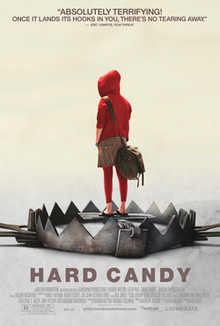
Movies You Should Totally See: Hard Candy

Aristotle said that a good play should take place in a single location, contain a single central act and should have a time span of less then 24 hours. Most movies break these rules almost immediately, but there is a certain quaint type of film that still sticks to these rules. One room, a few people, real time. No flashy action, no grand narratives, just people talking.

Hard Candy had a grand total of three actors with dialogue, and one of those has about 20 seconds of screen time. Everything in it takes place within a single afternoon, within a single house. This is the house of Jeff, a charismatic photographer who mostly works with young girls. Very young girls. When the movie starts, we see him contacting his next model. He meets her in a coffeehouse, and invites her over. She pours them both cocktails. He suggests a photoshoot. She happily obliges. He fetches his camera. He walks back into the room. And he passes out. When he wakes up, he is tied to a chair, while the girl is mockingly looking down on him.


It's a bit of a cliche to call a film like this a game of cat and mouse, but the term was never more fitting. The girl has a plan, but how solid is the evidence for her accusations? How much is she telling? The man is into some fishy business, but does he actually deserve what is done to him? The film peels off the layers of lies slowly and deliberately, in a way that pretty much defines "gripping".

Aristotle based his rules on the theatre, an artform that (in his day) depended mostly on two things: a good script and great actors. The script of Hard Candy is perfectly fine, but you'll completely forget about it once the actors show up. Patrick Wilson does a great job as the man in a tight spot, but he is simply no match for Ellen Page. Watching her unleash all hell is a simply chilling experience, even more so because she portrays her character as a complete enigma. Even in the most vulnerable of moments it is never revealed how much she really knows, and when the movie is done many questions remain unanswered. It's an uncanny achievement, especially when you consider that Page was only 18 when she played the role.

But like the drama Aristotle described, this is something that first and foremost should be experienced. You can (and will) think about it all you want, but there will never be any conclusive answers. Hard Candy is a movie that will keep you in it's grip long after you've turned off your TV.  It's is a hell of ride, and not one you'll leave unscathed.

Alias

This just feels right. Don't really know why.

Sunday, November 28

Movies You Should Totally See: Synecdoche, New York

I was browsing DVDs with my mother one day when I stumbled upon this movie. I enthusiastically urged her to buy it, and she asked me what it was about. I thought for a while, and then said: "everything". She didn't buy it. Everything was too much for her.

I can see why she did this. Synecdoche, New York is not a movie for people who just want to unwind after a long day. In fact, of all the movies I have ever advocated on this blog, this might be the one that the fewest people will appreciate. Even the critics were polarized about the movie: Roger Ebert called it the best movie of the decade, while others called it pretentious, too complex and generally stuck up it's own ass.  And I have to admit, you have to swallow quite a bit of Charlie Kaufman's crazy imagination to make any sense of the movie. But if you're willing to give yourself over to the movie you will find it's incomparably deep and moving. Or at least unlike anything you've ever seen before.

Synecdoche is first and foremost about life. The story is true to it's source: huge, complicated and sometimes downright bizarre. We follow the protagonist, Caden Cotard, from his midlife crisis to his death. The first part of the movie shows him being just another unhappy guy with a broken marriage. His job as a theatre director grants him some satisfaction, as do his awkward flirts with the receptionist Hazel, but even in those areas he mostly ends up frustrated. It's then that he gets the chance of a lifetime: a grant of 500.000 dollars to make a play. His ultimate work of art. He sets out to recreate his entire life in a gigantic empty warehouse, and hires actors to play himself and everyone around him. When the original people and the actors who play their love interests start falling in love the movie gets so devilishly complex that I won't even attempt to explain it. 

Synecdoche is not a movie in which the symbolism is subtly interwoven with the movie. The symbolism is the movie. Everything about the characters, from their names to their tiniest actions, is relevant and meaningful in some way. But I appreciate Charlie Kaufman (the director) for doing this. He takes the audience seriously, and throes them into the deep to show it. There is so much to say and to discuss that no time is wasted on stuff we can figure out by ourselves. It doesn't make for easy viewing, but it helps make the movie as labyrinthine and massive (in the best way possible) as it is.


This is not a happy movie. In fact, it's a rather sad movie. It shows old people who got busy dying (to quote a phrase) a long time ago, and are now desperately trying to leave some mark behind. It also a movie about how we are all trying to set up our lives like an enormous play, with ourselves as protagonists, just so we can make any sense of the crazy world we live in. This movie is a slap of reality and a dreamy exploration of life at the same time. Both a movie about creation and destruction. Both a flawless masterpiece and a self-absorbed pretentious pile of shit. Maybe I was wrong about saying that this movie was about everything. In a very strange way, this movie is everything: beautiful, worthless, strange, haunting, saddening, and ultimately pointless. Like all great art. And like all great pieces of art, this is not something you will ever completely figure out or agree about. Which is exactly what makes it worthwhile.

Alias

Ladies and gentleman: The Album Leaf!

Saturday, November 20

Movies You Should Totally See: American Psycho

I noticed that I had discussed almost every director I had anything meaningful to say about in my Pulling Rabbits pieces. So I decided to start a new column, styled after Roger Eberts Great Movies column. My goal is to make a list of movies that are not only good, but also accessible to people who aren't very much "into" movies. So no matter how great they are, films like A Bout de Souffle or Battleship Potemkin won't be on the list. Nor will movies like Star Wars or The Matrix: everybody has already seen those anyway. No, what I want to focus on are movies that receive a lot of love from their fans, but are a little too often overlooked by the general public. I know this definition will be controversial, but please don't complain if a movie is more well-known then I thought.

Okay, on to the movie.

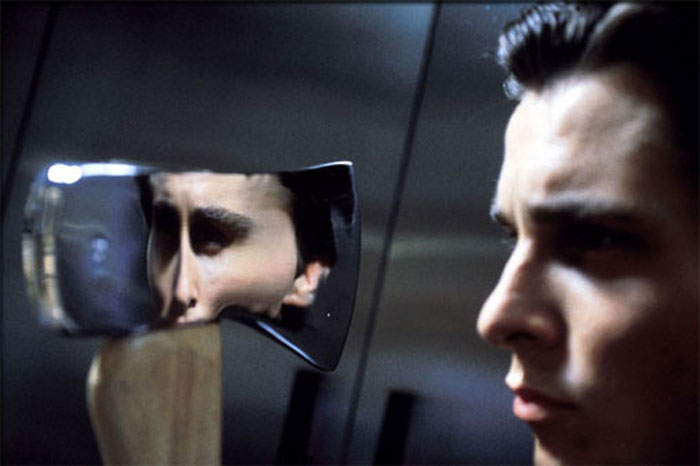
Patrick Bateman is everything you want to be. He is successful, rich, sexy and always impeccably dressed. He is born into wealth, educated at Harvard and currently residing in a lofty penthouse in Manhattan, with a view over Central Park. His hobbies include listening to music, working out and attending formal parties.

And randomly stabbing people to death.

Beneath his "mask of sanity", as he calls it, Patrick is a sick, deeply perverted psychopath, who has zero regard for the lives of people whom he sees as "beneath him". This is almost everybody. But that is not to say he is simply apathetic: there are some thing he cares about very deeply. He literally becomes sick to the stomach when one of his business partners has a better business card then he does, for example.


The way the film portrays this thouroughly skewed set of values is one half of what makes this movie so great. Everything we see is shows through the perspective of Bateman himself. Which means that all the bloody murder is shown in a way that is just as trivial as Bateman perceives it, while the business card scene seems to take forever. That is what's truly important to the man, after all. This modus operandi, combined with a great style, makes it sometimes pretty hard to take a step back and realize that these are business cards. And that this guy is a serial killer.

But it's the worldview of the movie that sets it aside from a normal slasher flick. Bateman, even though he is deeply disturbed (he even admits this himself), just doesn't get stopped. By anyone. He operates in full view, but no-one really seems to care. His belongings and his looks are the only thing people judge him by, not who he really is. And maybe, just maybe, his rich and successful friends know but just don't mind. I mean, who misses a few hobos?

Or some cheap whore?

It's not hard to see why anyone would want to stop Jason Voorhees, but Bateman just has the luck to be born in a time where a good image can make or break you. Regardless of who you are. Just think of all those young starlets of whom the entire world has an opinion, despite never having met them.

This film is a very biting satire of yuppie culture, and with those people plunging the world in the worst economic depression in a century it has only become more sickening. I don't think that drawing a parallel between dealing irresponsibly with the lives of so many people worldwide and direct murder is overdrawn: the amount of people that have literally died of famine because the bank account of the world is in the shitters far exceeds that of any serial killer. But what really made my stomach turn is the realization that we live in a society that not only keeps these people in charge, but actively encourages them to take the crushing risks they took.

For the more literary among you: this is THE adaptation of Bonfire of the Vanities. It's not an easy movie to watch, and you should definitely avoid watching it with your parents, but if you can stomach some gore you are in for a very intelligent view on a society that is, sadly enough, still very much reminiscent of ours.

Alias

This song is about a different serial killer, but no less chilling.